

Most people blame their hair loss on the wrong thing. Stress, shampoo, that one bad haircut. Sometimes it's none of those. Sometimes your body is simply starved of something it needs, and your follicles are the first thing to notice.
This is telogen effluvium. Diffuse shedding triggered when your body runs short on the nutrients it needs to keep follicles in active growth. It's not the same animal as androgenetic alopecia, the genetic, patterned thinning that affects up to 50 million men and 30 million women in the US. Different cause. Different fix.
Two deficiencies have the strongest evidence behind them: iron and vitamin D. But that doesn't mean the rest of your nutrient profile doesn't matter. Let's get into where supplementation genuinely earns its place.
Which nutritional deficiencies are linked to hair loss?
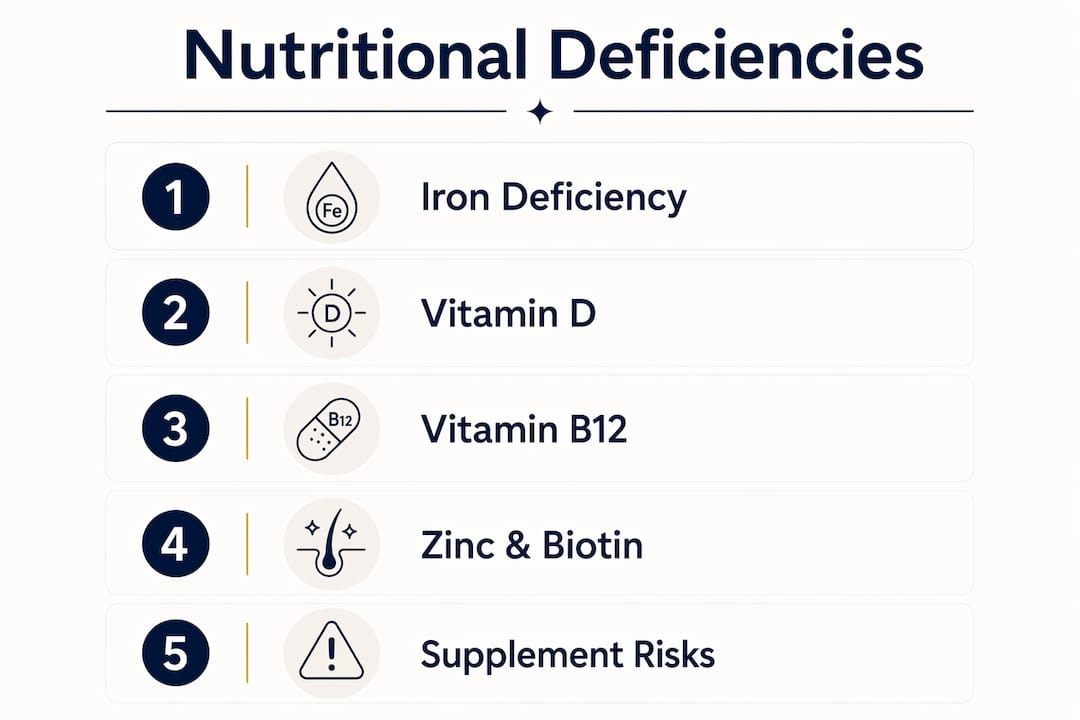
The four nutrients with the clearest clinical connection to hair shedding are iron, vitamin D, vitamin B12, and zinc. Biotin is also frequently marketed for hair health and plays an important role.
Iron and ferritin
This is the big one. Iron deficiency is the single most common nutritional cause of diffuse shedding, especially in women of reproductive age. But here's where most people get tripped up. Doctors check serum iron. They should be checking ferritin, the protein that actually stores iron in your body.
Optimal ferritin for hair health sits between 40 and 70 ng/mL. Standard lab ranges will often wave through results way below that and call them "normal." Your hair doesn't care what the lab calls normal. It cares whether there's enough ferritin to fuel follicle activity.

Since launching LIVDOR, I've received plenty of emails from people trying to understand why they're suddenly losing hair. One thing that comes up surprisingly often is someone saying they've already had blood tests and were told everything looked normal. I always suggest asking whether ferritin was checked specifically, because for healthy hair growth it's one of the most important markers to understand. It's a simple question that can sometimes uncover a piece of the puzzle that would otherwise be missed.
Vitamin D
Your follicle cells have vitamin D receptors sitting right there waiting to be fed. Low levels, more shedding. That's the pattern, consistently. Correcting vitamin D above 20 to 30 ng/mL is the standard clinical target. Some practitioners push higher.
Deficiency is everywhere in the UK. Limited sun does that. If you're testing one thing this month, make it this.
Vitamin B12
Common in vegetarians, vegans, and anyone over 60 whose absorption has slowed down. The mechanism is straightforward: less B12 means fewer red blood cells, which means less oxygen reaching your follicles. Confirm it with a blood test, fix it with supplementation. Not complicated.
Zinc and biotin: where supplementation actually earns its place
Zinc is mostly tied to alopecia areata, not general diffuse shedding. And the dosing window is narrow. Too little, follicle cells die off faster. Too much, you deplete copper and trigger a different kind of shedding entirely. There's no "more is better" here.
Biotin's reputation has been growing as an excellent supplement for hair growth. If you are not deficient, it offers little benefit. That's the honest answer, and we'd rather tell you that than sell you a bottle of false hope. But for those who are, Biotin supplements can give great results.
Here's where it gets useful, though. Biotin is one piece of a wider nutrient picture, not a standalone fix. People on restrictive diets, heavy training schedules, or anyone whose intake of eggs, nuts, and wholegrains is patchy can genuinely run low without realising it. That's why our Biotin Gummies, 5000mcg, are formulated as a straightforward, properly dosed daily top-up, not a megadose gimmick. Cheap insurance against a gap you can't always test for, used alongside the nutrients that actually move the needle.
How deficiencies hijack the hair growth cycle
Hair follicles are some of the most metabolically demanding tissue in your body. Cut the nutrient supply, and they react fast.
Here's the sequence:
- A key nutrient drops below the threshold follicles need to function
- Follicles push into telogen, the resting phase, earlier than they should
- Shedding follows, usually two to three months later
- Thinning spreads diffusely across the scalp, not in a pattern
- Once the deficiency is corrected, follicles return to growth, though visible improvement takes 3 to 6 months
That delay trips people up constantly. They had a rough month back in March. They notice the shedding in June. They don't connect the two. The body doesn't shed instantly. It shows you the bill weeks later.
Deficiencies also weaken the hair shaft itself, not just the root. Severe protein deficiency, causing breakage, is rare in places like the UK, but extreme dieting or malabsorption can still trigger it. Worth knowing the difference between strands snapping and follicles shedding. They look similar. They're not the same problem.
What happens when you over-supplement?
Here's the part nobody wants to hear. Taking more of a "hair vitamin" can make your hair loss worse. Not better. Worse.
Excess vitamin A, selenium, zinc, and iron can all actively trigger shedding. Selenium toxicity alone has caused hair loss in a significant share of exposed cases. Zinc oversupplementation depletes copper, which your hair needs for pigment and follicle function. Iron overload is toxic to multiple organ systems and should never be taken without a confirmed deficiency. Never.
One thing I've noticed from speaking to customers is how easy it is to assume that more supplements must mean better results. I've had conversations with people taking several different hair products at the same time without ever having a blood test first. My advice is always the same: understand what's causing the hair loss before adding more supplements. Hair loss can have many different causes, and finding the root cause is far more important than simply taking more tablets.
High-dose biotin causes its own headache, separate from whether it helps hair at all. It interferes with thyroid and cardiac blood tests, throwing off results that doctors then have to chase down. Stop high-dose biotin at least 3 to 5 days before any blood draw. This is exactly why our gummies are dosed sensibly rather than stacked sky high for a marketing headline.
The risk breakdown, roughly:
- Vitamin A — high risk, directly causes shedding at toxic doses
- Selenium — high risk, hair loss reported in the majority of toxicity cases
- Zinc — moderate risk, secondary shedding via copper depletion
- Iron — moderate risk, organ toxicity, never supplement blind
- Biotin — low direct risk, but messes with your lab results at high doses
Nutrients that help at normal doses turn against you at excessive ones. Test first. Always. Then dose sensibly.
And the timeline. Three to six months before you see anything. That's biology, not a failure of the plan. You can't out-dose your way to faster regrowth. Patience beats dosage every time.
Where to get these nutrients from food
- Iron — red meat, lentils, spinach, fortified cereals
- Vitamin D — oily fish, egg yolks, fortified dairy, sunlight
- Vitamin B12 — meat, fish, dairy, fortified plant milks
- Zinc — shellfish, pumpkin seeds, beef, chickpeas
- Biotin — eggs, almonds, sweet potato, wholegrains
A decent diet covers most of this for most people. Supplementation earns its place when absorption is impaired, intake is restricted, or a blood test confirms a real gap.
The takeaways, stripped down
- Test before you supplement. Ferritin, vitamin D, and B12 panels prevent wasted money and avoidable harm.
- Ferritin targets matter more than "normal" lab ranges. Aim for 40 to 70 ng/mL.
- Recovery takes 3 to 6 months. There's no shortcut.
- Excess nutrients cause shedding, not just deficiencies. Dose sensibly.
- Biotin alone is overhyped. Biotin as part of a complete, properly dosed routine, like a daily gummy alongside the nutrients with stronger evidence, is a reasonable everyday safeguard, especially if your diet has gaps.
One customer's journey really sticks with me because it reinforced something I already believed. She'd been experiencing increased shedding and discovered she had a nutritional deficiency after speaking with her GP. Once that was corrected, she introduced our laser hair growth cap to support her follicles while new hair growth came through. Over the following months the excessive shedding settled and she started to notice healthier, fuller looking hair. It's a good reminder that for many people there isn't one magic solution. The best results often come from identifying the underlying cause and then supporting healthy hair growth with a consistent routine.
Supporting your hair beyond nutrition
Fixing a deficiency lays the groundwork. It's rarely the entire picture. For people still seeing ongoing thinning despite eating well, pairing it with a clinically supported therapy makes a real difference.
Our laser hair growth cap uses 272 medical-grade lasers to deliver low-level laser therapy straight to the scalp, stimulating follicle activity at a cellular level. It works alongside nutritional correction, not instead of it. We also make UK-made hair growth vitamins, formulated as a complete profile to back up a balanced diet rather than replace good testing, alongside standalone options like our Biotin Gummies, 5000mcg for anyone whose diet leaves a gap. If you want the full picture of what's available, our complete hair loss solutions range covers everything from topical serums through to advanced laser therapy.

-
FAQ
What's the most common nutritional cause of hair loss?
Iron deficiency, specifically low serum ferritin. Optimal ferritin for hair health sits at 40 to 70 ng/mL, often higher than standard lab "normal" thresholds.How long until hair grows back after fixing a deficiency?
Three to six months. That's the natural hair growth cycle. Higher supplement doses won't speed it up.Can taking too many vitamins cause hair loss?
Yes. Excess vitamin A, selenium, zinc, and iron can all cause shedding. Selenium toxicity especially. Zinc oversupplementation depletes copper and triggers secondary shedding. This is exactly why dosing matters as much as which nutrients you take.Does biotin actually help hair growth?
It earns its place as a sensibly dosed daily habit alongside iron, vitamin D, B12, and zinc, covering the gaps a normal diet might miss rather than acting as a standalone fix.How do I know if my hair loss is nutritional or genetic?
Nutritional shedding is diffuse, spread across the whole scalp. Genetic hair loss follows a pattern, usually the crown or temples. A blood test plus a chat with a trichologist or GP will sort out which one you're dealing with.Recommended for you: Hair Growth Vitamins, UK-made · Hair Growth Serum 30ml · Biotin Shampoo with Caffeine · Biotin Conditioner with Caffeine · Biotin Gummies, 5000mcg



Leave a comment
This site is protected by hCaptcha and the hCaptcha Privacy Policy and Terms of Service apply.