

The hair growth cycle is a continuous biological process that controls how every strand on your scalp grows, rests, and sheds. It is divided into four distinct phases: anagen, catagen, telogen, and exogen. Understanding the science of hair growth cycle mechanics explains why hair thins, why treatments take time to work, and which interventions genuinely support follicle health. A healthy scalp sheds 50–100 hairs daily, and that is entirely normal. What matters is whether your follicles are cycling efficiently and spending enough time in the growth phase.
What are the phases of the hair growth cycle?
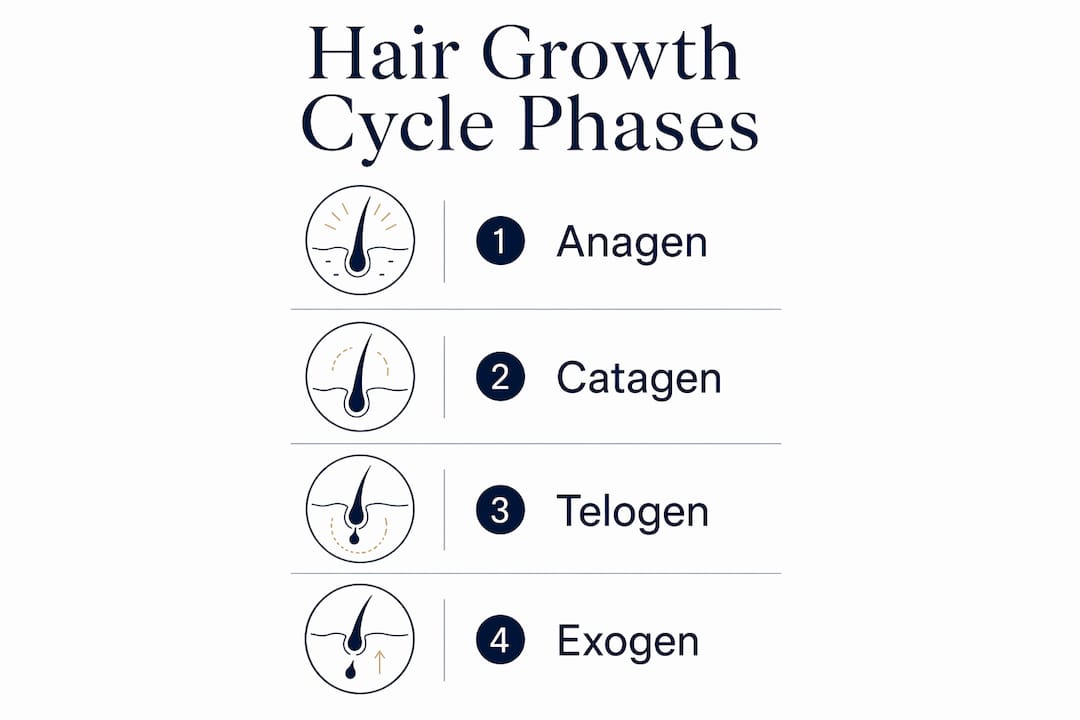
Each follicle on your scalp operates independently, cycling through four stages at its own pace. That independence is why you do not lose all your hair at once.
| Phase | Duration | Follicle percentage | Key feature |
|---|---|---|---|
| Anagen | 2–7 years | 85–90% | Active growth; hair shaft produced |
| Catagen | 2–3 weeks | 1–2% | Regression; follicle shrinks |
| Telogen | 3–4 months | 10–15% | Resting; club hair anchored |
| Exogen | Days to weeks | Overlaps telogen | Active enzymatic shedding |
Anagen is the growth phase. The anagen phase lasts 2–7 years, with men averaging 2–6 years and women closer to 5 years. Hair grows roughly 1 cm per month during this phase, so the longer your anagen, the longer your potential hair length.
Catagen is a brief transition lasting 2–3 weeks. The follicle detaches from its blood supply and begins to shrink. Only 1–2% of follicles are in catagen at any given moment.
Telogen is the resting phase, holding the old hair shaft, called a club hair, firmly in place. Between 10–15% of follicles rest here at any time. This phase lasts roughly 3–4 months before the follicle reactivates.
Exogen is the phase most people overlook. It is not passive hair falling out. Exogen is an active enzymatic process that releases the club hair from the follicle. It can overlap with both telogen and the early stages of a new anagen, which is why you sometimes shed hair while new growth is already beginning beneath the surface.
How do molecular signals control hair cycling?
The hair growth cycle is not random. It is governed by a precise set of cellular signals, and understanding them changes how you think about hair loss.
The dermal papilla sits at the base of each follicle and acts as the command centre for growth. When dermal papilla cells signal correctly, anagen begins. When their activity declines, the follicle stalls in telogen and hair density drops.
The most important signalling pathway is Wnt/β-catenin. Wnt signalling activates follicle stem cells at the start of anagen, with β-catenin accumulating in the nucleus to switch on growth genes. When this pathway is disrupted, the hair cycle arrests and progressive thinning follows.
The stem cells responsible for regeneration live in a structure called the bulge, located in the permanent portion of the follicle. The follicle bulge houses slow-cycling stem cells that activate in late telogen to regenerate the lower follicle and restart anagen. This is a critical point: thinning follicles are not necessarily dead. They are often dormant, waiting for the right signals.
Hair follicles also behave like mini-organs with an intrinsic oscillator, a kind of internal clock that times each phase. When this oscillator is disrupted, more follicles shift into telogen simultaneously, and hair appears to thin rapidly.
Hormonal factors compound these effects. Testosterone, particularly its derivative dihydrotestosterone (DHT), reduces dermal papilla cell signalling and shortens the anagen phase over successive cycles. Crucially, follicles have a finite cycling capacity of roughly 20–25 cycles. Accelerated cycling burns through this capacity faster, which is why early intervention matters.
- Dermal papilla cells initiate anagen through direct signalling to the follicle matrix
- Wnt/β-catenin pathway drives stem cell activation at the start of each growth phase
- The bulge reservoir ensures follicles can regenerate, provided signals are intact
- Hormonal disruption shortens anagen and accelerates the depletion of cycling capacity
- Intrinsic follicle oscillators time each phase; desynchronisation causes visible thinning
Pro Tip: Knowing that follicles are dormant rather than destroyed gives you a realistic basis for patience. Restoration treatments work by re-stimulating existing biology, not creating new follicles from scratch.
What causes hair thinning in terms of cycle science?
Hair thinning is not simply about losing hair. It is about losing the balance between phases.
When dermal papilla cell activity declines, anagen is delayed and telogen is prolonged. More follicles rest simultaneously, and the scalp produces fewer active hairs. Reduced dermal papilla signalling prolongs telogen and delays the start of new growth, directly reducing hair density. This is the core mechanism behind most forms of hair thinning.
Follicle miniaturisation compounds the problem. Each successive cycle produces a slightly shorter, finer hair shaft. Eventually, the follicle produces only a thin vellus hair, barely visible to the naked eye.
Shedding can also appear alarming when it is actually normal. Because follicles cycle asynchronously, a sudden increase in shedding often reflects a wave of follicles transitioning from telogen to exogen at the same time. Telogen hairs resemble anagen hairs visually, so the shed appears sudden even though the cycle shift began months earlier.
Here is how to distinguish normal shedding from a genuine problem:
- Normal daily shedding falls within 50–100 hairs and reflects routine telogen-to-exogen transitions.
- Telogen effluvium occurs when a physical or emotional stressor pushes a large proportion of follicles into telogen simultaneously, causing a noticeable shed 2–3 months after the trigger.
- Androgenetic alopecia involves progressive miniaturisation driven by DHT, shortening anagen across successive cycles.
- Nutritional deficiency disrupts dermal papilla signalling, particularly deficiencies in biotin and key nutrients, which impair the cellular machinery of growth.
- Cycle acceleration from any cause depletes the follicle’s finite cycling reserve faster than normal, leading to permanent thinning over time.
How can cycle science guide hair restoration?
Applying the science of hair development stages to treatment choices produces far better results than guessing. The goal is always the same: extend anagen, protect follicle cycling capacity, and re-stimulate dormant dermal papilla cells.
Low-level laser therapy (LLLT)
The most clinically supported at-home treatment for follicle stimulation is low-level laser therapy. A 650nm wavelength laser cap delivers photobiomodulation directly to the scalp, increasing cellular energy production in dermal papilla cells and encouraging the transition from telogen to anagen. Livdor’s laser hair growth cap uses 272 medical-grade lasers at this precise wavelength, making it one of the most thorough at-home devices available.
Nutritional and topical support
Laser therapy works best when paired with targeted nutritional and topical support. Each product targets a different part of the growth mechanism:
| Treatment type | Mechanism | Expected benefit |
|---|---|---|
| LLLT laser cap (650nm) | Photobiomodulation of dermal papilla cells | Follicle reactivation, anagen extension |
| Caffeine shampoo | Blocks DHT at follicle level, stimulates circulation | Reduced miniaturisation, improved scalp health |
| Rosemary conditioner with saw palmetto | Natural DHT inhibition, scalp conditioning | Supports anagen maintenance |
| Biotin conditioner | Strengthens hair shaft structure | Reduced breakage, improved density appearance |
| Hair growth serum with biotin, caffeine, and Pro-Vitamin B5 | Multi-pathway follicle stimulation | Thicker, stronger hair shaft production |
| Biotin gummies | Systemic nutritional support for keratin synthesis | Supports anagen phase from within |
Biotin supports keratin production, the structural protein that forms the hair shaft. Caffeine, applied topically via a caffeine-based shampoo, penetrates the follicle and counteracts DHT’s shortening effect on anagen. Saw palmetto in a rosemary conditioner provides natural DHT inhibition at the scalp surface. A hair growth serum combining biotin, caffeine, and Pro-Vitamin B5 addresses follicle stimulation from multiple angles simultaneously.
Clinical results typically appear after 3 months of consistent treatment. This delay reflects the asynchronous nature of follicle cycling. Not every follicle responds at the same time, so visible density improvement takes several cycles to accumulate.
Pro Tip: Combining an LLLT laser cap with a targeted serum, a caffeine shampoo, and biotin gummies addresses the cycle at the cellular, topical, and systemic levels at once. That multi-layered approach produces noticeably better results than any single treatment used alone.
Key takeaways
The science of hair growth cycle mechanics shows that thinning is a cycle disruption problem, not simply a shedding problem, and that targeted, consistent treatment can restore follicle activity.
| Point | Details |
|---|---|
| Four distinct phases | Anagen, catagen, telogen, and exogen each play a specific biological role in hair production and shedding. |
| Finite follicle capacity | Each follicle completes roughly 20–25 cycles; protecting anagen duration preserves long-term hair density. |
| Dormant, not dead | Thinning follicles retain stem cells in the bulge and can be reactivated with the right signals. |
| Three-month treatment window | Visible results require at least three months due to asynchronous follicle cycling across the scalp. |
| Combined approach works best | LLLT paired with biotin, caffeine, and saw palmetto targets the cycle at cellular, topical, and systemic levels. |
Why patience and early action are the real secrets
I have spent years looking at the research on hair cycling, and the insight that changed my thinking most was this: follicles are not lost, they are waiting. The bulge stem cell reservoir remains intact in most cases of early thinning. The problem is that the signals telling those stem cells to activate have weakened.
What frustrates me is how many people wait until thinning is advanced before acting. By that point, several cycles have already been lost. The finite cycling capacity of each follicle means every delayed cycle is a cycle you cannot get back. Early intervention is not just helpful. It is the difference between preserving what you have and trying to recover what is already gone.
The other thing I want to be honest about is timelines. Three months feels like a long time when you are watching your hairline change. But that delay is built into the biology. Asynchronous cycling means follicles respond at different times, and consistent treatment is the only way to accumulate those responses into visible density. The people who give up at six weeks are the ones who never see results.
My practical advice is to start with a quality LLLT laser cap and build a supporting routine around it. The laser does the heavy lifting at the cellular level. The serums, shampoos, and nutritional support fill in the gaps. That combination respects the biology rather than fighting it.
— Adam Bond
Livdor’s science-backed hair growth range
If you are ready to support your hair cycle with clinically grounded tools, Livdor offers a complete range built around the same biology this article covers.

The Livdor laser hair growth cap uses 272 medical-grade lasers at 650nm to stimulate dermal papilla cells and encourage the shift from telogen back into anagen. Pair it with Livdor’s caffeine shampoo, Rosemary Conditioner with Saw Palmetto, Biotin Conditioner, and the hair growth serum containing biotin, caffeine, and Pro-Vitamin B5 for a multi-layered approach. Biotin Gummies provide systemic nutritional support from within. Every product is drug-free, gentle on the scalp, and designed to work with your follicle biology rather than against it. Results typically begin to show from three months of consistent use.
FAQ
What are the four phases of the hair growth cycle?
The four phases are anagen (active growth), catagen (regression), telogen (rest), and exogen (active shedding). Each follicle cycles through these phases independently at its own pace.
How long does the anagen phase last in men?
The anagen phase in men typically lasts 2–6 years, slightly shorter than in women. This shorter duration limits maximum hair length and contributes to faster visible thinning when the phase is further shortened by DHT.
Why does hair thinning happen at the follicle level?
Hair thinning occurs when dermal papilla cell signalling weakens, prolonging telogen and shortening anagen across successive cycles. Follicle miniaturisation follows, producing progressively finer hair shafts until growth becomes barely visible.
How long does it take to see results from hair loss treatment?
Clinical results typically appear after a minimum of three months of consistent treatment. This delay reflects the asynchronous cycling of follicles, which respond at different times rather than all at once.
Can dormant follicles be reactivated?
Yes. Dormant follicles retain stem cells in the bulge region and can return to active growth when dermal papilla signalling is restored. Treatments such as LLLT, targeted serums, and DHT-blocking topicals work by re-stimulating this existing biology.



Leave a comment
This site is protected by hCaptcha and the hCaptcha Privacy Policy and Terms of Service apply.