
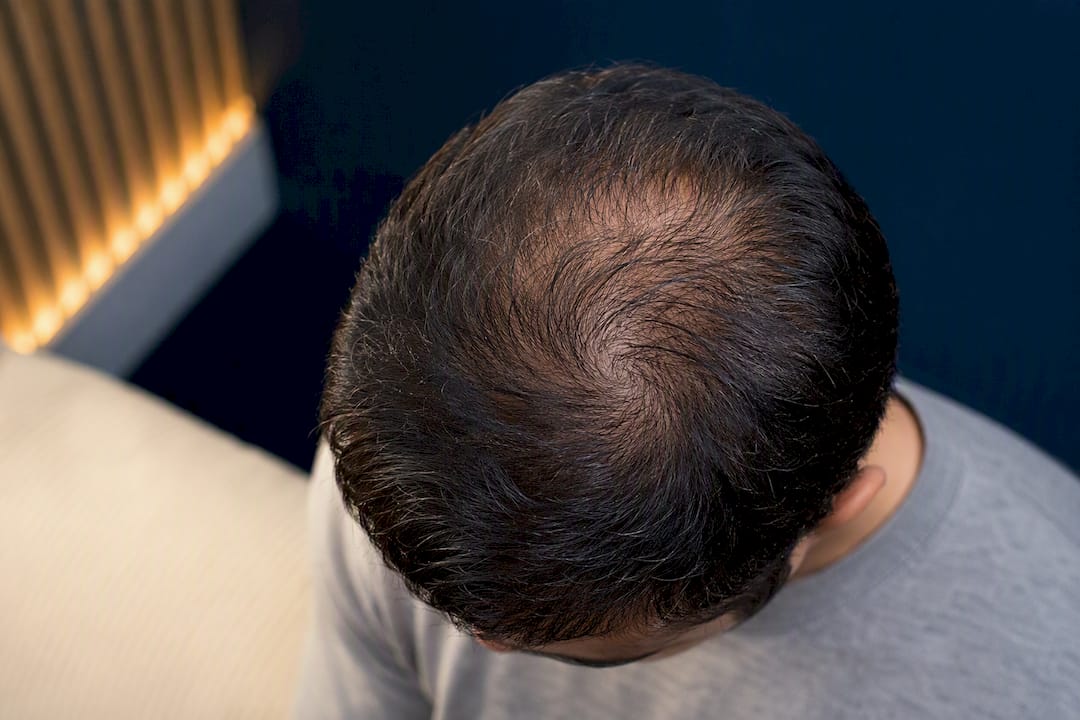
The best approach to vertex thinning combines what has the strongest evidence with what you’ll actually stick to. Topical minoxidil is the first-line option for almost everyone, and oral finasteride adds meaningful benefit for eligible men. Low-level laser therapy (LLLT) is a genuinely useful drug-free adjunct you can use at home, while PRP, microneedling, and transplant surgery sit further down the list for advanced or stubborn cases. See a clinician before starting a prescription medicine, and start an at-home routine sooner rather than later since crown hair tends to reward early, consistent treatment.
Finasteride is FDA-indicated for men only. Women who are or may become pregnant must not handle crushed or broken finasteride tablets, due to the risk of harm to a male fetus. It can also cause sexual side effects (reduced libido, erectile dysfunction) in a minority of men, which usually resolve after stopping treatment. Discuss these risks with a physician before starting.
TL;DR:
- Minoxidil remains the primary over-the-counter treatment for vertex thinning, with the best evidence supporting its effectiveness when used consistently for at least three months.
- Finasteride can add significant benefit for men and requires a discussion of potential sexual side effects and risks before use, with full benefits often appearing after six to twelve months.
- Low-level laser therapy is a proven drug-free option that works best with high-quality devices used three to four times weekly over several months.
- Diagnosis of vertex thinning should be prompt if experiencing rapid shedding, patchy loss, scalp irritation, or additional symptoms indicating underlying health issues.
- Advanced or stable cases might require procedures like PRP, microneedling, or hair transplant surgery, but these are usually considered only after medical treatments have plateaued or in specific instances.
What causes thinning at the vertex, and how is it different from other hair loss?
The vertex is the whorl-shaped crown at the back of your head, where hair naturally spirals around a central point. It’s also usually the first place androgenetic alopecia shows up, well before most people notice their hairline receding, because the follicles there carry a particularly high sensitivity to dihydrotestosterone (DHT).
Androgenetic alopecia, sometimes called male or female pattern hair loss, accounts for the overwhelming majority of vertex thinning cases. DHT binds to receptors in genetically susceptible follicles and gradually shrinks them in a process called miniaturisation. Each hair that grows back is finer and shorter-lived than the one before it, until some follicles stop producing visible hair altogether. This is also why the crown often responds differently to treatment than the hairline does: vertex follicles tend to stay in a “dormant but alive” state for longer, which gives medical therapy more to work with. Minoxidil’s original pivotal trials actually focused on the vertex specifically, which is part of why the evidence for crown regrowth is so much more consistent than for frontal or temple regrowth.
Not every case of crown thinning is androgenetic, though, and mistaking one cause for another wastes time on the wrong treatment. Other conditions can produce a similar pattern:
- Telogen effluvium — a temporary, diffuse shedding triggered by illness, stress, childbirth, or rapid weight loss, usually resolving on its own within months.
- Alopecia areata — an autoimmune condition causing patchy, sometimes sudden hair loss that can affect the crown but looks and behaves differently under close inspection.
- Thyroid dysfunction — both an underactive and overactive thyroid can thin hair diffusely, including at the vertex.
- Nutritional deficiencies — low iron, ferritin, or vitamin D levels are commonly checked when hair loss doesn’t fit a typical pattern.
Distinguishing between these matters because the urgency and treatment path differ sharply. Androgenetic alopecia is progressive but rarely urgent, so you have time to research and choose a plan. Alopecia areata or rapid, unexplained shedding deserves a faster clinical opinion, partly because some of those causes are reversible once the trigger is treated. MedlinePlus notes that crown balding is extremely common, and that starting treatment earlier gives you better odds of stabilising the loss and holding on to what you’ve got.
How is vertex thinning diagnosed, and when should you see a clinician?
Most crown thinning can be assessed with a straightforward clinic visit, but a few warning signs mean you shouldn’t wait. Book an appointment sooner rather than later if you notice any of the following:
- Rapid or heavy shedding — clumps of hair coming out over days or weeks rather than a slow, gradual thinning over years.
- Patchy rather than diffuse loss — distinct bald patches, especially with a smooth, shiny scalp surface, point away from typical pattern loss.
- Scalp pain, itching, or visible irritation — this can signal an inflammatory or infectious cause that needs its own treatment before hair regrowth is even possible.
- Loss alongside other symptoms — fatigue, weight changes, or brittle nails can suggest a thyroid or nutritional issue worth ruling out.
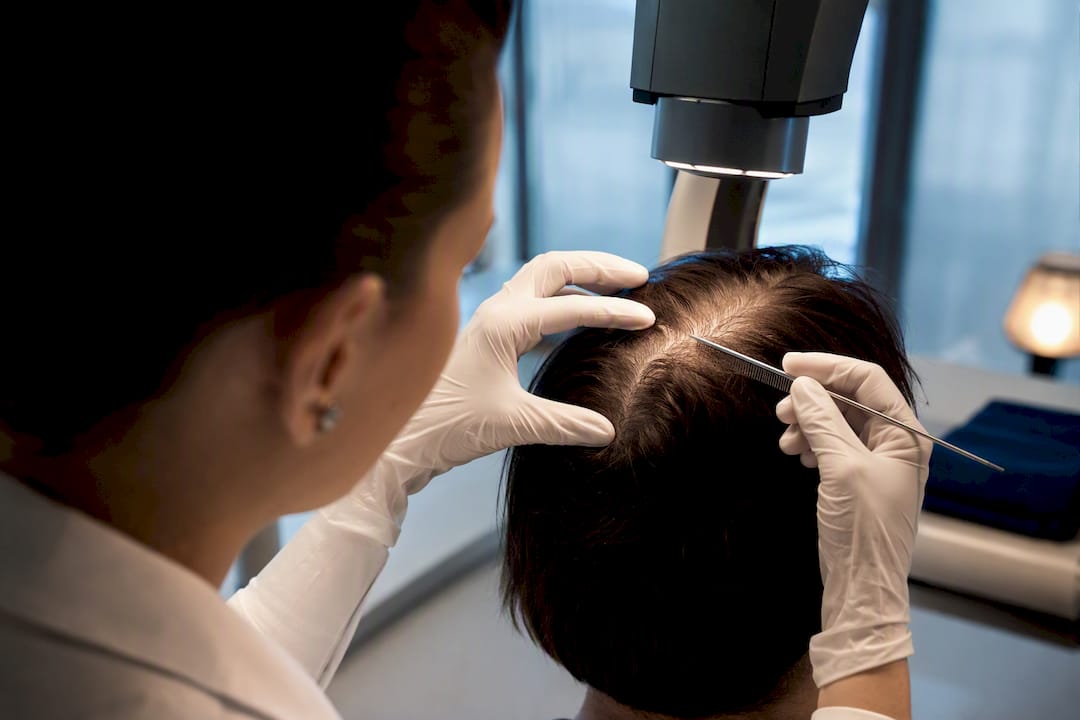
A typical clinical workup for vertex thinning starts with a detailed history: when it started, family pattern, medications, recent illness or stress, and diet. From there, most clinicians take standardised photographs from the same angle and distance at each visit, since side-by-side comparison over months is far more reliable than memory. A trichoscopy (magnified scalp examination) or a simple hair pull test helps distinguish active shedding from stable miniaturisation. Where the history suggests a non-androgenetic cause, selective blood tests, iron and ferritin, thyroid function, and vitamin D, help rule those in or out.
Staging matters more than most people expect. A clinician will usually classify vertex loss on a scale that reflects how much follicle density remains and whether any hair is still visibly growing in the affected area. Early-stage thinning, where follicles are miniaturised but active, responds far better to topical and light-based therapy than advanced loss, where follicles may have gone dormant for years. That staging directly shapes which treatments are worth trying first and which are unlikely to help much on their own.
What medical treatments actually work for vertex thinning?
Two medicines carry the strongest evidence for androgenetic alopecia at the crown, and a systematic clinical review places topical minoxidil, oral finasteride, and LLLT above procedures like PRP for consistency of results.
Low-dose oral minoxidil requires medical supervision: it can cause fluid retention, a faster heart rate, and lowered blood pressure, so clinicians typically monitor blood pressure and ask about heart conditions before prescribing. It is not recommended during pregnancy or breastfeeding. Discuss these risks with a physician before starting.
Topical minoxidil
Minoxidil is the most extensively studied topical treatment for vertex hair loss, and it’s the only over-the-counter option with FDA-approved labelling specifically for this area. The 5% solution’s package insert specifies application of 1 mL, twice daily, applied directly to the dry scalp rather than the hair itself.
Minoxidil’s evidence gap between crown and hairline exists for a specific reason: its original trials were designed and measured around vertex response, which is why so many product labels still reference this area by name rather than the frontal scalp.
What should you expect, realistically? Many people notice a temporary increase in shedding during the first two to six weeks. This is a normal part of the hair cycle resetting, not a sign of worsening loss, though it understandably alarms people who don’t know it’s coming. Visible improvement, thicker-looking regrowth and reduced shedding, typically appears between three and six months of consistent, twice-daily use. Stopping treatment reverses the benefit within a few months, so this is a long-term commitment rather than a course you complete and finish.
Older clinical guidance is also worth knowing: research from American Family Physician found that minoxidil and finasteride mainly prevent further loss and produce modest regrowth, with younger men and those with more recent-onset thinning responding best. That’s not a reason to skip treatment, but it does mean setting expectations around “stabilise and partially regrow” rather than “reverse completely.”
Oral finasteride
Finasteride works through an entirely different mechanism: it’s a 5-alpha reductase inhibitor, meaning it blocks the enzyme that converts testosterone into DHT. Since DHT sensitivity drives most vertex thinning in men, lowering circulating DHT levels reduces the ongoing miniaturisation of follicles.
Finasteride is only approved for men, and typical response windows run longer than minoxidil, often six to twelve months before the full benefit becomes apparent. Because it works systemically rather than just on the scalp, it comes with side effects worth discussing openly with a clinician before starting:
- Sexual side effects (reduced libido or erectile difficulty) affect a minority of men and are usually reversible on stopping.
- Finasteride lowers PSA (prostate-specific antigen) readings, so anyone being monitored for prostate health needs this factored into blood test interpretation.
- Mood changes have been reported by some patients and are worth flagging early if they occur.
Oral minoxidil
Some clinicians now prescribe low-dose oral minoxidil off-label, particularly for patients who find the topical solution irritating or impractical to apply daily. It isn’t FDA-approved for hair loss specifically, and it carries its own considerations, including blood pressure monitoring and a higher risk of unwanted body hair growth compared with the topical version. This route belongs firmly in the “discuss with your clinician” category rather than a self-directed choice.
What procedural options exist for the crown, and who actually needs them?
In-clinic procedures earn their place when topical and oral treatments have plateaued, or when someone wants a faster or more dramatic result than medical therapy alone can deliver.
Platelet-rich plasma (PRP) involves drawing a small amount of your own blood, concentrating the platelets, and injecting that plasma into the scalp to stimulate follicles. Evidence for PRP is described as showing benefit for hair density in early thinning, though results vary between studies and typically require multiple sessions, often three to four initial treatments spaced a month apart, followed by maintenance visits. PRP tends to suit people with early-to-moderate thinning who still have a reasonable density of active follicles; it does little for scalp that’s already gone smooth and shiny.
Microneedling creates controlled micro-injuries in the scalp using fine needles, which is thought to trigger a wound-healing response that boosts absorption and effectiveness of topical treatments. It’s rarely used as a standalone therapy. The typical protocol involves sessions once or twice weekly, either at home with a dermaroller or in-clinic with a more precise device, usually paired with minoxidil applied shortly afterwards.
Hair transplant surgery (FUE or FUT) remains the most durable option for restoring density where follicles have already been lost for good. Vertex transplants carry a specific technical challenge that hairline work doesn’t: matching the natural whorl direction so the transplanted grafts blend with the existing swirl pattern rather than sitting at odds with it. Surgeons plan graft angle and density carefully around this, and donor hair availability becomes a real constraint since crown coverage often demands a large number of grafts.
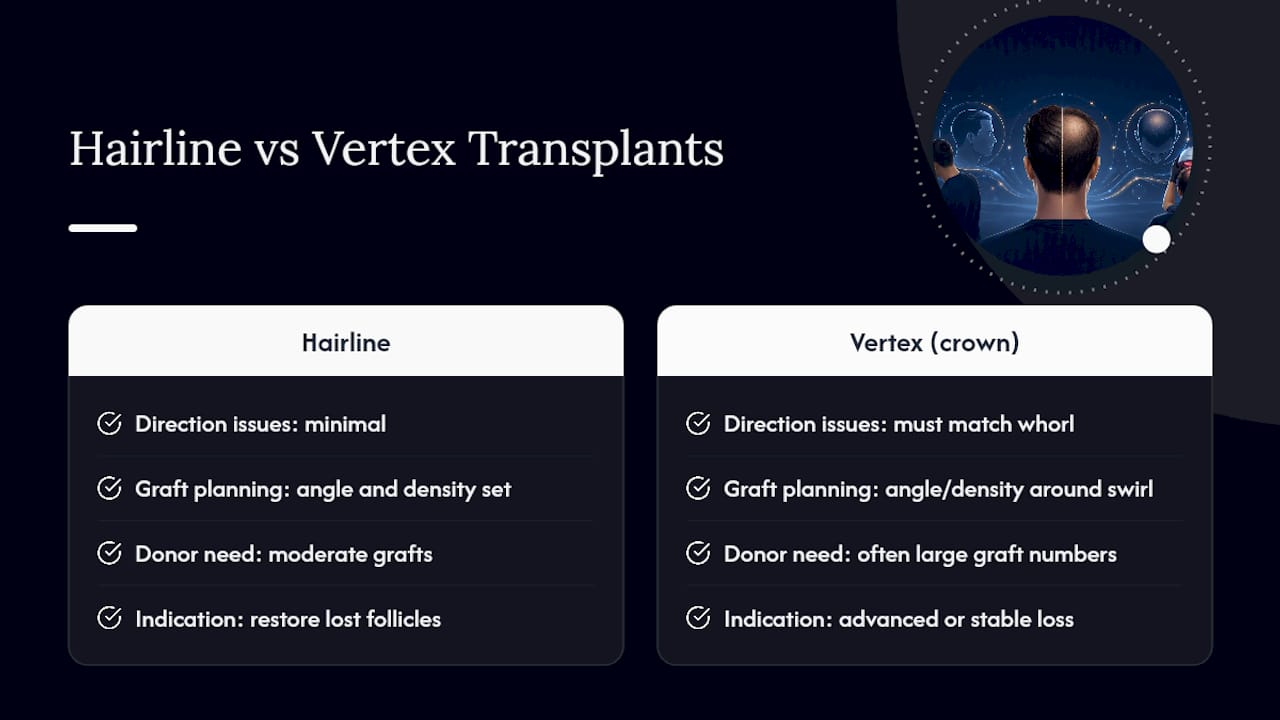
Pro Tip: If you’re considering a transplant, ask your surgeon specifically how they plan to address the whorl pattern. A vertex transplant that ignores the natural spiral direction can look uneven even when the density is technically good.
Recovery from FUE typically takes seven to ten days before you can return to normal activity, with final results visible closer to twelve months as transplanted follicles cycle through their natural growth phases. Transplant surgery is generally reserved for advanced or stable loss, since operating on an area still actively thinning from ongoing androgenetic alopecia means new hairs will keep shrinking around the transplanted ones unless medical treatment continues alongside it.
Do drug-free, at-home options like LLLT actually work?
Low-level laser therapy is the most evidence-backed drug-free option available for vertex thinning, and it’s one you can use entirely at home. It works by delivering red or near-infrared light at specific wavelengths, commonly around 650nm, to the scalp, which is thought to stimulate cellular activity within the hair follicle and support the transition of resting follicles back into an active growth phase.
Clinical trials of low-level laser therapy report improved hair counts and density with regular use over several months, and some devices have been cleared specifically for this purpose. Response tends to follow a similar rhythm to minoxidil: many users report visible change by around three months of consistent use, with fuller results building over six to twelve months.
Device quality is not a minor detail with LLLT. Clinical reviews note that laser dose and device design meaningfully affect outcomes, which is why a medical-grade cap with a proper wavelength and even scalp coverage performs very differently to a cheaper, underpowered alternative.
For best results, LLLT sessions are typically used three to four times a week for around ten to twenty minutes, depending on the device’s laser configuration. Consistency matters more than intensity. A drug-free hair thinning routine built around LLLT works well precisely because it fits into daily life without the side-effect conversations that come with prescription medicines.
Supporting products round out a drug-free plan without replacing the laser therapy itself:
- Caffeine and biotin shampoos help cleanse the scalp gently while delivering ingredients associated with follicle support, without the harsh sulphates found in many everyday shampoos.
- Rosemary conditioner with saw palmetto pairs a botanical often compared to mild DHT-blocking action with a scalp-conditioning routine that keeps hair manageable during regrowth.
- Hair growth serum with biotin, caffeine, and pro-vitamin B5 targets the scalp directly between wash days, layering additional nutrients onto the follicle environment LLLT is working to stimulate.
- Biotin gummies support hair health from within, and are genuinely useful where a deficiency exists, though they won’t move the needle much if your biotin levels are already normal.
None of these supporting products replace medical treatment where it’s indicated, but combined with a quality LLLT device, they build a coherent, natural approach that doesn’t require a prescription.
How do you combine treatments, and what’s a realistic timeline?
Sequencing matters as much as the treatments themselves. Someone with early, mild vertex thinning might start with LLLT and a supportive serum alone, adding minoxidil if progress stalls after a few months. Someone with moderate, established thinning generally does best starting minoxidil and LLLT together from day one, since they work through different mechanisms and the evidence doesn’t suggest they interfere with each other. Advanced cases, where follicles have likely gone dormant, usually need a clinician’s input on finasteride, PRP, or transplant candidacy, run alongside daily LLLT and topical treatment rather than instead of it.
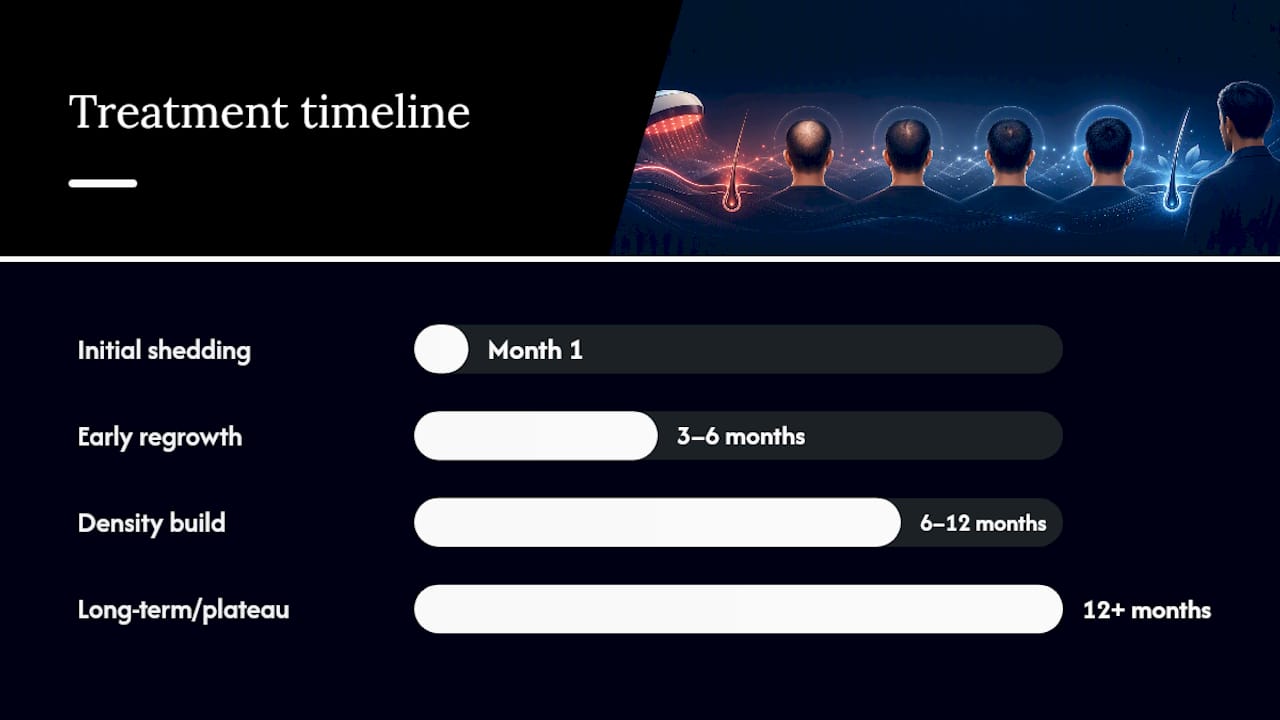
A realistic month-by-month picture looks like this:
- Month 1 — Shedding may temporarily increase as minoxidil resets hair cycles; this is expected and settles within weeks, not a sign to stop.
- Months 3 to 6 — Early regrowth signs appear for many people: finer new hairs, reduced shedding, less scalp visibility in good light. This is when clinical timelines suggest responders typically notice their first measurable change.
- Months 6 to 12 — Visible density changes build, and this is the point most clinicians recommend a formal reassessment, ideally with standardised photographs compared against your baseline.
- 12 months and beyond — For those pursuing transplant surgery, this is roughly when final results become apparent as grafts complete their growth cycle; for medical and light-based therapy, this marks the point where results plateau into a maintenance phase.
Track progress properly rather than relying on memory or a bathroom mirror at random angles. Take photos monthly, same lighting, same distance, same angle, ideally with a fixed reference point like a ceiling light or door frame in the background. If you’ve followed a treatment consistently for six months with genuinely no change, that’s the point to go back to your clinician and reconsider the plan, not before. Premature switching between treatments is one of the most common reasons people conclude “nothing works” when they simply didn’t give any single approach long enough.
What daily habits actually support hair regrowth?
Treatment does the heavy lifting, but daily habits either support it or quietly undermine it. Gentle handling matters more at the crown than almost anywhere else on the scalp, since vertex hair is often already finer and more fragile than hair elsewhere.
- Avoid tight hats, tight ponytails, or anything that puts sustained tension on thinning areas.
- Skip harsh sulphate shampoos and high-heat styling tools where possible; both strip natural oils and stress fragile strands.
- Pat hair dry rather than rubbing vigorously with a towel, particularly straight after washing when hair is at its weakest.
- Ask your clinician before starting iron, vitamin D, or biotin supplementation blind. Correcting a genuine deficiency can support hair health, but supplementing without a confirmed deficiency rarely adds benefit and occasionally causes its own problems.
- Consider a daily scalp care routine that keeps the scalp environment healthy without overloading it with product.
While treatments take months to show results, temporary cosmetic strategies help in the meantime. Root touch-up powders, volumising mousses, and strategic parting can all reduce scalp visibility without any risk of interfering with your actual treatment plan. These are a bridge, not a solution, but there’s no reason to feel self-conscious for months while waiting for biology to catch up with your routine.
Why does Livdor focus on high-quality LLLT for vertex thinning?
Livdor’s position on vertex thinning is straightforward: evidence-backed medical treatment comes first where it’s appropriate, and a genuinely well-built, drug-free LLLT device belongs alongside it, not as a lesser substitute. That’s a deliberate stance rather than a marketing convenience. The clinical literature on low-level laser therapy is consistent enough that a quality device, used correctly, earns its place in a serious treatment plan.
Livdor’s laser hair growth cap uses 650nm wavelength medical-grade lasers designed to deliver even, consistent coverage across the scalp, which matters because uneven laser dosing is one of the most common reasons cheaper LLLT devices under-deliver. Customers using the cap alongside supporting products, the biotin and caffeine shampoo, the rosemary conditioner with saw palmetto, and the biotin gummies, are following exactly the layered approach that clinical reviewers describe as sensible: light therapy to stimulate follicles, topical nutrients to support the scalp environment, and internal supplementation where a deficiency genuinely exists.
Pro Tip: When comparing LLLT devices, check the wavelength (650nm sits within the evidence-supported range), the number of laser diodes, and the warranty length. A device backed by a proper warranty usually signals a supplier confident in its own build quality.
For anyone combining LLLT with prescription minoxidil or finasteride, there’s no known conflict between the approaches. If anything, they tend to complement each other, addressing the problem through different biological pathways at once.
What should you do next if you’re noticing vertex thinning?
Start with the basics before anything else, and don’t let uncertainty about which treatment is “best” delay you from doing anything at all.
- This week: take standardised baseline photos of your crown under consistent lighting, and start a topical treatment or LLLT session if your thinning looks like typical pattern loss.
- Within a month: book a clinician review if loss is rapid, patchy, or accompanied by scalp irritation, or if you’re an eligible man considering finasteride.
- Ongoing: use your chosen treatment consistently for a minimum of three to six months before judging results, tracking with monthly photos rather than daily mirror checks.
- If progress stalls: return to your clinician to discuss adding a second treatment (minoxidil plus LLLT, or finasteride where appropriate) rather than abandoning what you’re already doing.
- For advanced or stable loss: ask specifically about PRP or transplant candidacy, since these routes work best once your clinician confirms the loss pattern has stabilised.
| Situation | Recommended first step | Typical timeline to reassess |
|---|---|---|
| Early, mild vertex thinning | LLLT plus supportive serum/shampoo | 3 months |
| Moderate, established thinning | Minoxidil plus LLLT together | 3 to 6 months |
| Eligible men, no improvement on minoxidil alone | Add finasteride after clinician review | 6 to 12 months |
| Advanced loss, follicles likely dormant | Clinician referral for PRP or transplant assessment | 6 to 12 months |
Persisting through the first few months is genuinely the hardest part, mostly because nothing visible happens quickly. That’s normal, not a sign of failure.
Why the standard hair loss advice undersells drug-free options
Most hair loss content treats LLLT as an afterthought, a “you could also try” line tucked beneath minoxidil and finasteride. That undersells what the evidence actually shows. LLLT sits in the same tier of supported therapies as the two leading medicines, not a rung below them, and it comes without the side-effect conversations that make some people delay treatment altogether while they weigh up finasteride’s risks.
The bigger gap in conventional advice is sequencing. Too many guides present medical, procedural, and drug-free options as competing choices you pick between, rather than layers you build. The people who do best combine approaches early: a quality LLLT device from day one, topical minoxidil where appropriate, and supporting products that reinforce the scalp environment rather than substitute for it.
What should you prioritise first? Consistency over intensity. A modest, well-built routine followed for six months beats an aggressive multi-treatment plan abandoned after six weeks. Pick your evidence-backed starting point, commit to it properly, and let the timeline do its work.
— Adam Bond
How Livdor supports your vertex thinning treatment plan
Livdor is the drug-free alternative to relying on prescription medicine alone for vertex thinning, built around a genuinely medical-grade LLLT device rather than a diluted, underpowered version of the technology. If the sections above left you deciding between minoxidil, finasteride, or a laser cap, the honest answer is that they work well together, and Livdor’s cap is designed specifically to be the drug-free half of that combination.

The Laser Hair Growth Cap uses 650nm medical-grade lasers across its full coverage area, engineered to reach the vertex evenly rather than concentrating light on the crown’s centre while leaving the edges under-treated, a common weakness in cheaper caps. Livdor backs the device with a warranty and ongoing customer support, and pairs it naturally with the hair growth serum featuring biotin, caffeine, and pro-vitamin B5, the rosemary conditioner with saw palmetto, and biotin gummies for anyone whose levels need topping up. Used together, this range gives you a complete, science-backed, at-home routine that fits around any medical treatment your clinician recommends.
If you’re ready to build a proper drug-free plan for vertex thinning, start by browsing the full laser hair growth product range or explore the Hair Growth Starter Kit for a device and supporting products bundled together.
This article is general information, not a substitute for advice from a qualified doctor. Consult a qualified healthcare professional about your own circumstances before acting on anything here.
Sources
- Minoxidil topical solution 5% — DailyMed (FDA package insert)
- Treatment options for androgenetic alopecia: Efficacy, side effects, compliance, financial considerations, and ethics — PMC
FAQ
What does thinning at the vertex mean?
Vertex thinning refers to hair loss at the crown, the whorl-shaped point at the back of the head, and it’s usually the earliest visible sign of androgenetic alopecia in both men and women.
How do you fix vertex balding?
Topical minoxidil is the primary evidence-backed treatment, often combined with LLLT as a drug-free adjunct; eligible men may add oral finasteride, while PRP or transplant surgery are reserved for advanced or stable cases where medical treatment alone hasn’t been enough.
Is minoxidil only good for vertex thinning?
No, but its evidence is strongest there because minoxidil’s original pivotal trials were designed around vertex response, which is why crown regrowth tends to be more consistent than frontal hairline regrowth.
What causes thinning at the crown?
Androgenetic alopecia, driven by DHT sensitivity in genetically susceptible follicles, causes most vertex thinning, though telogen effluvium, thyroid dysfunction, and nutritional deficiencies can produce a similar pattern and need separate assessment.

Leave a comment
This site is protected by hCaptcha and the hCaptcha Privacy Policy and Terms of Service apply.