
TL;DR:
- Early detection of male pattern hair loss through clinical staging improves treatment outcomes. Starting interventions at stages 1 to 3 allows for more options and better long-term results. Combining scalp support, nutritional supplements, and laser therapy offers the most effective approach across different stages.
Androgenetic alopecia (AGA) is the clinical term for male pattern hair loss, and it is the leading cause of hair thinning in men worldwide. Using a structured hair thinning stages men checklist is the most reliable way to catch changes before they become difficult to reverse. Approximately 30% of men show clinically relevant AGA by age 30, with 25% showing signs before age 21. That statistic means thinning often begins in your twenties, long before most men think to look. The Norwood scale and the BASP (Basic and Specific) classification are the two clinical standards used to stage progression. Knowing where you sit on either scale gives you a clear starting point for action.
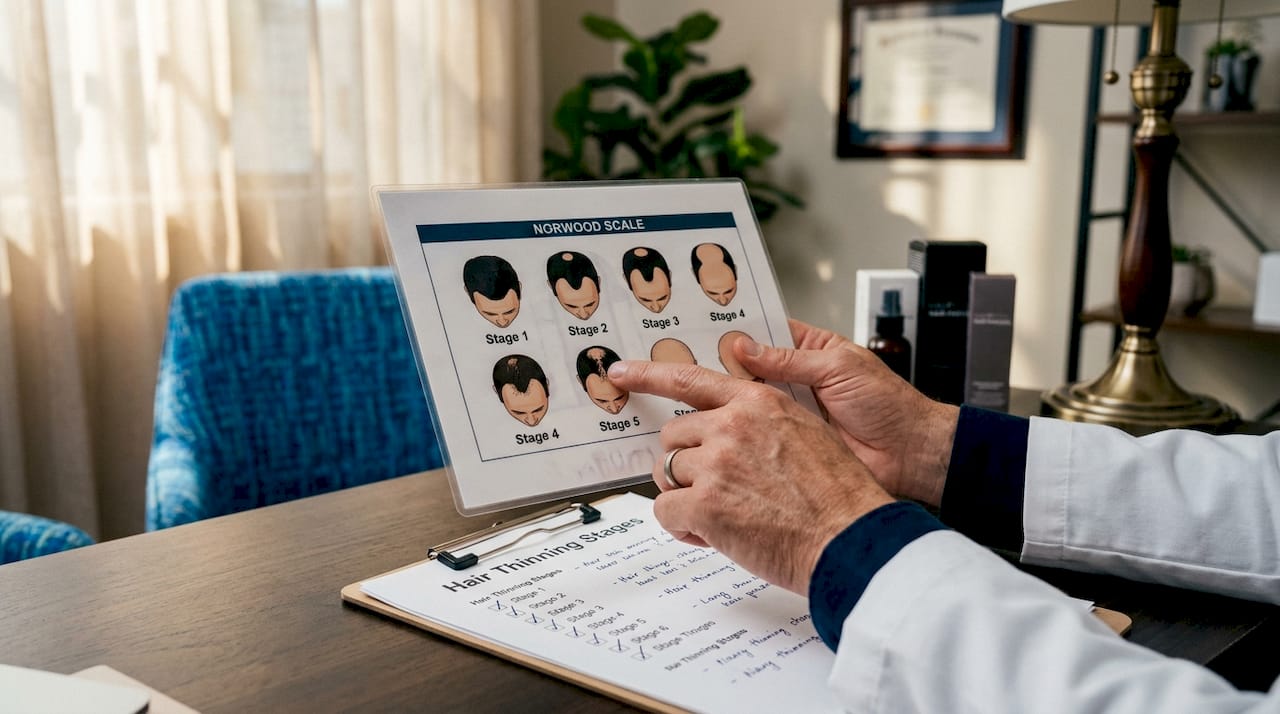
1. The hair thinning stages men checklist: Norwood scale explained
The Norwood scale runs from Stage 1 to Stage 7 and maps the typical progression of male pattern hair loss. Each stage has observable features you can check against your own hairline and crown.
- Stage 1: No visible recession. Hairline sits at or above the upper forehead crease. No thinning at the crown.
- Stage 2: Slight recession at the temples. The hairline begins to form a shallow “M” shape. Hair density appears normal elsewhere.
- Stage 3: Deeper temple recession. The “M” shape is clearly visible. Some men also notice early crown thinning (Stage 3 Vertex).
- Stage 4: Significant frontal recession and a distinct bald patch at the crown. A band of hair still separates the two areas.
- Stage 5: The band of hair between the frontal and crown areas narrows considerably. Both zones of thinning are large and visible.
- Stage 6: The separating band disappears. Frontal and crown thinning merge into one large area.
- Stage 7: Only a horseshoe-shaped rim of hair remains around the sides and back of the scalp.
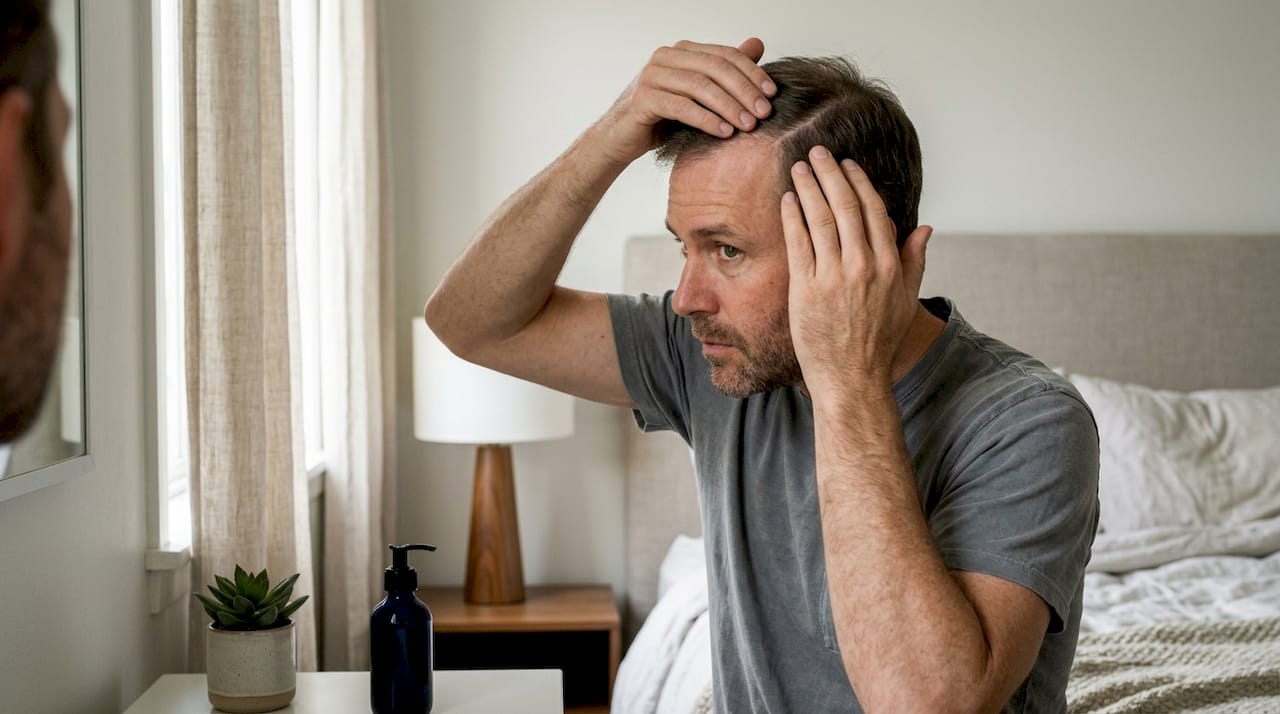
Beyond the hairline, check for a widening parting line, increased scalp visibility under bright light, and strands that feel finer or more brittle than they used to. Hair fibre thickness variations are more predictive of AGA progression than counting hairs on your pillow or brush. Finer, shorter strands that no longer grow long are a stronger warning sign than shedding alone.
Pro Tip: Take a photo from the same angle, under the same lighting, once a week. A bathroom with a fixed overhead light works well. Side-by-side comparisons over four to eight weeks reveal changes that are invisible day to day.
2. Biological and clinical markers beyond what you can see
Visible thinning is the last thing to appear, not the first. Follicular miniaturisation begins well before you notice any change in the mirror. This is a microscopic process where each hair follicle gradually shrinks, producing thinner, shorter, and weaker strands over successive growth cycles. A dermatologist can detect it using trichoscopy, a non-invasive scalp imaging technique, long before you spot it yourself.
Understanding the difference between AGA and telogen effluvium matters enormously for choosing the right response.
- Androgenetic alopecia: Follows a predictable pattern (temples, crown). Progresses slowly over years. Driven by genetic sensitivity to dihydrotestosterone (DHT).
- Telogen effluvium: Causes diffuse shedding across the whole scalp. Typically triggered by stress, illness, surgery, or nutritional deficiency. Stress-related shedding usually appears two to four months after the trigger event and resolves once the cause is addressed.
- Normal shedding: Losing 50–100 hairs daily is entirely normal. Consistently losing 150–200 or more is a warning sign worth investigating.
Evaluating hair density and strand thickness matters more than counting shed hairs. A GP or trichologist can also assess your genetic risk and recommend a treatment pathway suited to your stage. Understanding the science of hair growth helps you interpret what your body is doing and why.
3. Common mistakes men make with early hair thinning
The most damaging mistake is waiting. Starting treatment in Norwood stages 1–3 dramatically improves outcomes and keeps more options open, including non-surgical ones. Men who delay until Stage 5 or 6 face a much narrower set of choices.
- Confusing telogen effluvium with AGA. Diffuse shedding after a stressful period is not the same as genetic thinning. Treating them identically wastes time and money.
- Assuming it is too late. Many men give up once thinning becomes visible. Follicles in the early stages of miniaturisation can still respond to treatment.
- Failing to track changes objectively. Relying on memory or mood-based perception leads to either panic or denial. Neither helps.
- Ignoring lifestyle contributors. Chronic stress, poor diet, and smoking worsen AGA by activating inflammation and disrupting hormone balance. These are controllable factors.
- Relying on a single treatment. Scalp-only shampoos without nutritional or follicle-level support rarely produce lasting results on their own.
Pro Tip: If you are unsure whether your shedding is stress-related or genetic, photograph your parting line monthly. AGA produces a progressively wider parting; telogen effluvium does not follow that pattern.
4. Management strategies mapped to each stage
The right intervention depends on where you are on the checklist. Early action produces the best results, and a combined approach consistently outperforms any single treatment. Combining topical actives with nutritional support enhances hair thickness and slows thinning progression more effectively than either approach alone.
Stages 1–2: Build your foundation
- Use a biotin and caffeine shampoo daily to stimulate the scalp and strengthen existing strands.
- Add a Saw Palmetto and Rosemary shampoo to your routine. Saw palmetto blocks DHT at the scalp level; rosemary supports circulation to the follicle.
- Take biotin gummies and a dedicated hair growth vitamin daily to address any nutritional gaps that accelerate thinning.
Stages 3–4: Add targeted topical support
- Introduce a hair growth serum containing biotin, caffeine, and Pro-Vitamin B5 (panthenol). Apply directly to the scalp after washing. These actives work at the follicle level, not just on the hair shaft.
- Continue the shampoo and supplement routine from Stages 1–2.
Stages 4–5: Introduce low-level laser therapy
LLLT caps emitting 650nm wavelength laser light reactivate follicles and improve hair density. This is among the most effective non-pharmaceutical treatments available for early-stage thinning. Livdor’s laser cap uses 272 medical-grade lasers to deliver consistent, clinically relevant energy to the scalp. Used alongside topical serums and nutritional supplements, it produces results that neither approach achieves alone.
| Treatment type | Key benefit | Best stage |
|---|---|---|
| Biotin and caffeine shampoo | Strengthens strands, stimulates scalp | Stages 1–7 |
| Saw Palmetto and Rosemary shampoo | DHT reduction, improved circulation | Stages 1–5 |
| Hair growth serum (biotin, caffeine, Pro-Vitamin B5) | Follicle nourishment, thickness | Stages 2–5 |
| Biotin gummies and hair vitamins | Nutritional support for growth cycle | Stages 1–7 |
| LLLT laser cap (650nm, 272 lasers) | Follicle reactivation, density increase | Stages 3–6 |
Addressing nutritional deficiencies alongside topical treatment closes a gap that many men overlook entirely.
5. How to monitor progression and maintain hair health long term
Consistent monitoring is what separates men who catch thinning early from those who notice it too late. A structured approach removes guesswork and gives you real data to act on.
- Set up a fixed photo station. Use the same room, the same light source, and the same camera angle every time. Overhead lighting reveals scalp visibility most clearly.
- Photograph weekly for the first month, then monthly. Standardised photography over 8–12 weeks is the most reliable way to track progression objectively. Single-week comparisons are too easily distorted by lighting or hair styling.
- Assess strand thickness, not just hairline position. Run your fingers through your hair and note whether strands feel finer than they did six months ago. Finer strands signal active miniaturisation.
- Allow a full 8–12 week window before judging any treatment. Hair grows in cycles. Changes in density and thickness take at least two to three months to become visible, even when a treatment is working.
- Seek a specialist assessment if you reach Stage 3 or above. A trichologist or dermatologist can confirm your Norwood stage, rule out other causes, and guide your treatment plan with clinical precision.
- Maintain your routine consistently. LLLT devices and topical serums require regular use to sustain gains. Stopping treatment typically reverses progress within a few months.
Exploring non-pharmaceutical remedies that are backed by evidence gives you a clear framework for what to use and when.
Key takeaways
The most effective approach to managing hair thinning in men is early identification using a clinical checklist, combined with a layered treatment plan that addresses follicle health, nutrition, and scalp stimulation simultaneously.
| Point | Details |
|---|---|
| Use the Norwood scale as your checklist | Map your hairline and crown against Stages 1–7 to establish your current position. |
| Follicular miniaturisation precedes visible loss | Finer, shorter strands are an earlier warning sign than hairline recession alone. |
| Distinguish AGA from telogen effluvium | Stress shedding is diffuse and temporary; AGA follows a predictable pattern at temples and crown. |
| Start treatment at Stages 1–3 | Early intervention keeps non-surgical options open and produces better long-term outcomes. |
| Combine LLLT, topicals, and nutrition | A layered approach consistently outperforms any single treatment for slowing progression. |
Why I think most men wait far too long
I have spoken with a lot of men about hair thinning, and the pattern is almost always the same. They notice something in their mid-twenties, tell themselves it is just the light, and do nothing for two or three years. By the time they act, they are at Stage 4 or 5, and the options have narrowed considerably.
The checklist approach changes that. When you have a concrete list of observable signs mapped to clinical stages, thinning stops being something vague and frightening and becomes something measurable and manageable. That shift in perspective is genuinely powerful.
What I find most encouraging is how much the science has moved on. LLLT technology, quality serums with proven actives like biotin and Pro-Vitamin B5, and targeted nutritional support like biotin gummies and hair growth vitamins give men at Stages 1–4 a real chance to slow progression and maintain density without pharmaceuticals or surgery. The key is combining them rather than picking one and hoping for the best.
Lifestyle matters too, more than most men realise. Chronic stress and poor diet actively worsen AGA by driving inflammation and hormonal disruption. Addressing those factors is not optional. It is part of the treatment.
Hair thinning is a manageable condition. It is not a fate you simply accept. The men who do best are the ones who start early, track consistently, and use the right tools in combination.
— Adam Bond
Livdor’s science-backed solutions for every stage
If this checklist has helped you identify where you are on the Norwood scale, the next step is building a routine that matches your stage.

Livdor’s Laser Hair Growth Cap uses 272 medical-grade lasers at the clinically proven 650nm wavelength to reactivate follicles and improve density at home, without drugs or invasive procedures. Pair it with Livdor’s Hair Growth Serum containing biotin, caffeine, and Pro-Vitamin B5, plus the Biotin and Caffeine Shampoo, Saw Palmetto and Rosemary Shampoo, Biotin Gummies, and Hair Growth Vitamins for a complete, layered approach. Visible results typically begin within three months of consistent use. Visit Livdor to find the right combination for your stage.
FAQ
What are the first signs of hair thinning in men?
The earliest signs are finer, shorter strands at the temples and crown, a slightly widening parting line, and increased scalp visibility under bright light. These appear before any obvious hairline recession.
How do I know if I have AGA or stress-related shedding?
AGA follows a predictable pattern at the temples and crown and progresses slowly over months or years. Telogen effluvium causes diffuse shedding across the whole scalp and typically resolves within six months of removing the trigger.
At what stage should I start treatment?
Starting treatment at Norwood Stages 1–3 produces the best outcomes and keeps non-surgical options available. Waiting until Stage 5 or beyond significantly narrows your choices.
Does LLLT actually work for hair thinning?
Yes. LLLT at 650nm wavelength stimulates follicles and improves hair density. It is most effective when combined with topical serums and nutritional supplements rather than used in isolation.
How often should I check my hair thinning progression?
Photograph your scalp weekly for the first month, then monthly thereafter. Allow an 8–12 week observation window before drawing conclusions, as hair growth cycles mean changes take time to become visible.



Leave a comment
This site is protected by hCaptcha and the hCaptcha Privacy Policy and Terms of Service apply.