
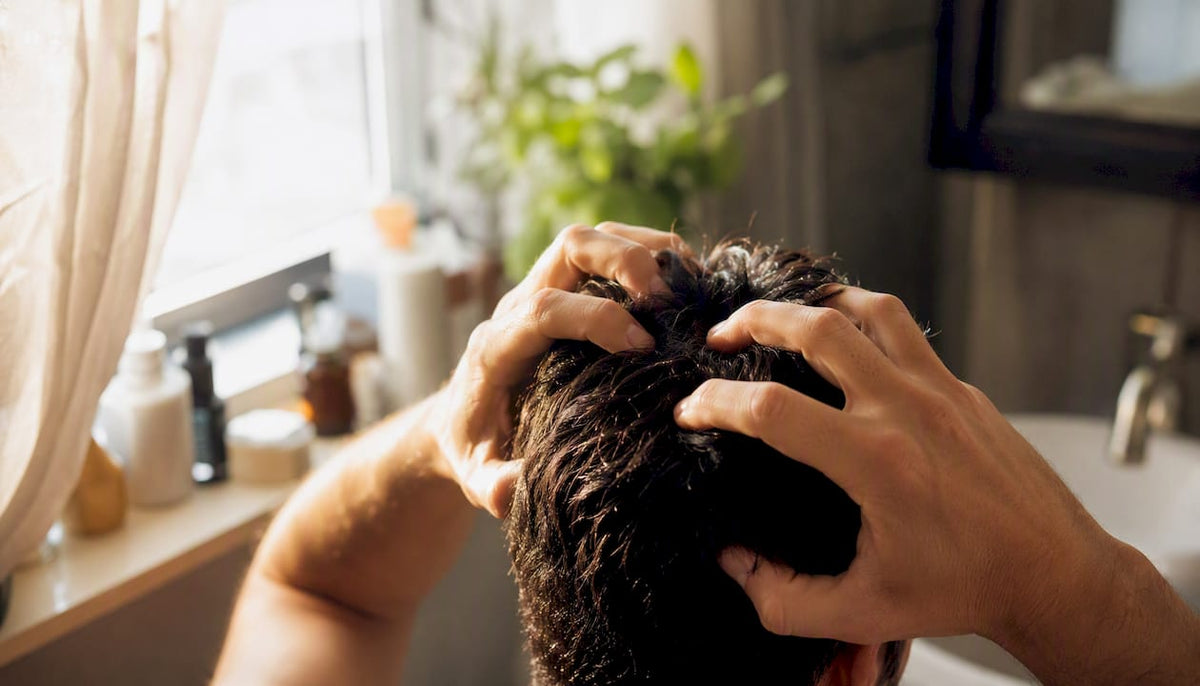
Scalp massage can support hair growth, but it is not a cure. The most-cited clinical evidence, a small controlled trial by Koyama et al. published in ePlasty, found that a standardised 4-minute daily massage over 24 weeks was associated with increased hair shaft thickness in healthy men. That is a meaningful signal, even from a small sample. UCLA Health and Healthline both describe the overall evidence as promising but inconclusive, noting that most positive reports come from small or self-reported studies.
The practical takeaway:
- Scalp massage is safe to try daily and carries very low risk when done correctly.
- It works best as part of a broader plan, not as a standalone treatment.
- Pairing it with clinically proven options such as low-level laser therapy (LLLT) and targeted serums gives you a much stronger foundation than massage alone.
Key takeaways
Daily scalp massage can increase hair shaft thickness over six months, but it works best as part of a consistent, multi-modal plan that includes LLLT, targeted serums, and nutritional support.
| Point | Details |
|---|---|
| Evidence is promising, not conclusive | The Koyama trial showed thickness gains at 24 weeks; larger rigorous trials are still needed. |
| Technique determines results | Move the scalp skin against the skull — mechanical stretch, not surface rubbing, is the active stimulus. |
| Expect changes at 6 months | Visible improvement typically takes at least 24 weeks; track progress with monthly standardised photos. |
| Combination therapy is stronger | Pairing massage with a 650nm LLLT cap, biotin serum, and biotin gummies targets multiple mechanisms at once. |
| Livdor for a complete routine | Livdor’s laser cap, hair growth serums, and biotin gummies offer a drug-free, evidence-aligned at-home system. |
What does the research actually show?
The evidence base is small but consistent in one direction. The Koyama et al. trial enrolled nine healthy Japanese men and had each perform a standardised 4-minute scalp massage daily for 24 weeks using a purpose-built device. At the end of the study, hair shaft thickness had increased compared with baseline. Critically, the researchers attributed this to mechanical stretching forces on dermal papilla cells in the subcutaneous tissue, not simply to improved blood flow. The limitation is obvious: nine participants, no control group, and a homogeneous sample.
A 2019 survey published in Springer captured a larger picture. Participants who followed a twice-daily massage regimen reported stabilisation or regrowth over time. The strength here is the larger number of respondents and the real-world adherence data. The weakness is that results were entirely self-reported, which introduces recall and expectation bias. Adherence also varied considerably between participants.
Key finding: The Koyama trial reported increased hair shaft thickness after 24 weeks of daily 4-minute massage — a promising result from a very small sample that warrants larger, rigorous follow-up.
Verywell Health’s editorial review echoes the same conclusion: two small human studies support benefits on thickness, but more research is needed before firm clinical recommendations can be made. The honest summary is that the signal is real, the certainty is not.
| Study | Design | Key outcome | Limitation |
|---|---|---|---|
| Koyama et al. (2016) | Controlled trial | Increased hair shaft thickness at 24 weeks | Very small sample, no control group |
| 2019 Springer survey | Self-reported survey | Stabilisation or regrowth reported by many participants | Self-report bias, variable adherence |
How might scalp massage influence hair follicles?
The most plausible mechanism is mechanical. When you move the scalp skin against the skull rather than simply rubbing the hair shafts, you transmit a stretching force directly to the dermal papilla cells that sit at the base of each follicle. The Koyama study specifically highlighted this pathway: dermal papilla cells respond to mechanical stretch by upregulating genes associated with hair growth.
Three supporting mechanisms are worth understanding:
- Improved local circulation. Massage increases blood flow to the scalp, which improves the delivery of oxygen and nutrients to follicles. Follicles in the anagen (active growth) phase are metabolically demanding, so better perfusion can support their activity.
- Lymphatic drainage. Gentle, rhythmic pressure helps clear metabolic waste and excess sebum from around the follicle opening, keeping the environment cleaner for growth.
- Stress reduction. Elevated cortisol is associated with premature entry into the telogen (resting/shedding) phase. Regular massage can lower local and systemic stress responses, which may help keep more follicles in the anagen phase for longer.
These mechanisms are biologically plausible and supported by broader scalp and hair biology research, though the direct causal chain in humans still needs larger trials to confirm.
How to massage your scalp effectively, step by step
Technique matters more than duration. Moving the scalp skin is the goal; simply running fingers through hair does almost nothing for follicle stimulation.
- Start at the nape. Place the pads of all ten fingers (not the nails) at the base of your skull. Apply firm but comfortable pressure and make small circular movements, moving the skin against the skull rather than sliding over it.
- Work up the sides. Move to the temples and sides, using the same circular press-and-hold motion. Spend roughly 30 seconds on each zone.
- Cover the crown. Use both hands simultaneously, fingers spread wide, pressing and rotating across the top of the head. This is the zone most associated with androgenic thinning, so give it extra attention.
- Finish at the hairline. Use thumbs along the frontal hairline with gentle upward pressure.
- Repeat daily. The Koyama protocol used 4 minutes; Health often recommend 10–20 minutes for people actively managing hair thinning, starting with 4–5 minutes and building up as it becomes habit.
Timing with products: Massage works well immediately after applying a serum, as the mechanical action helps drive active ingredients such as biotin, caffeine, and Pro-Vitamin B5 closer to the follicle. You can also massage during a conditioner application to soften the scalp and improve slip. Pre-shampoo massage on a dry scalp loosens sebum and debris before washing.
Pro Tip: Rather than counting seconds, use a short playlist or podcast segment as your timer. Consistency over months matters far more than any single session’s duration, and an enjoyable ritual is one you will actually keep.
Which tools and topicals genuinely help?
Fingertips vs tools
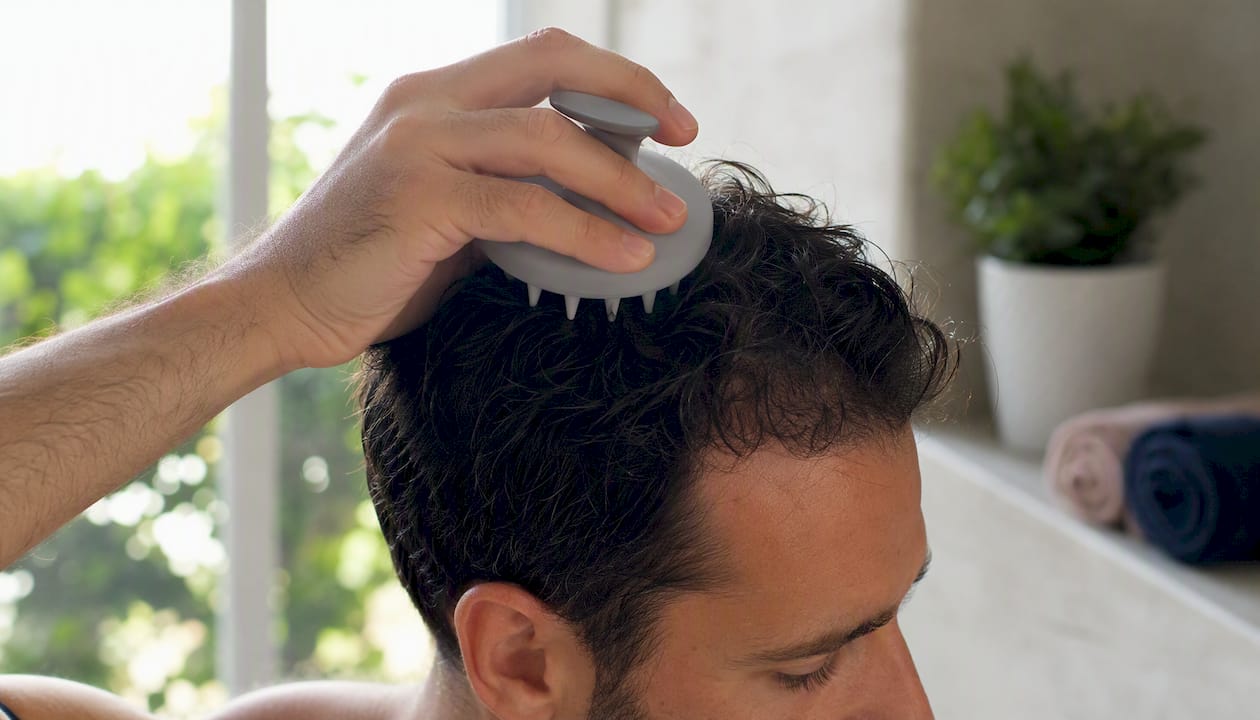
Your fingertips remain the most controlled and safest option. They let you feel the scalp’s response and adjust pressure instantly. Silicone scalp brushes with soft, rounded nubs are a reasonable upgrade: they cover more surface area per stroke and many people find them easier to use consistently. Electric massagers can deliver a more sustained mechanical stimulus, though they offer less tactile feedback and can cause tangling in longer hair if used carelessly.
Essential oils: limited but not zero evidence
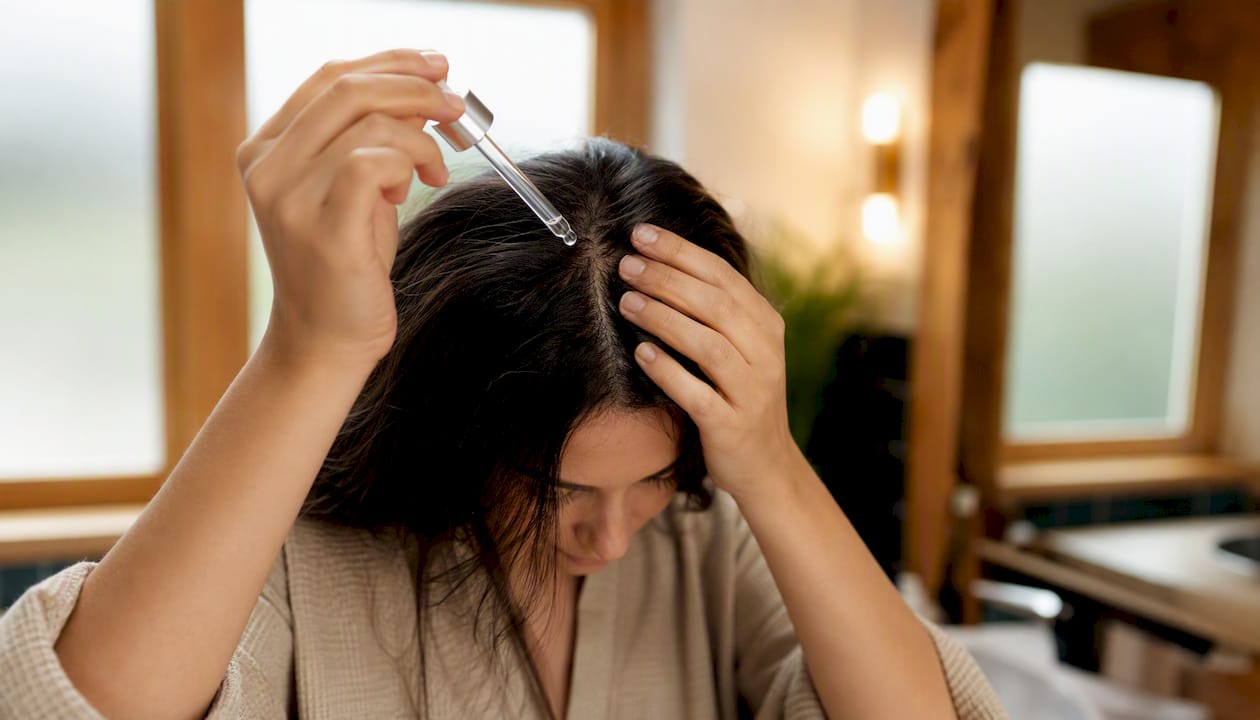
Peppermint and rosemary oils have the most studied profiles for scalp use. Animal studies and a small number of human trials suggest both may support follicle activity, but the evidence is nowhere near conclusive for humans. If you choose to use them:
- Always dilute in a carrier oil (jojoba, coconut, or argan) at roughly 2–3 drops per teaspoon of carrier.
- Patch test on the inner arm for 24 hours before applying to the scalp.
- Avoid open wounds, active dermatitis, or broken skin.
The Voraly Bio-Active Veganic Serum is one option for readers wanting a pre-formulated blend of bio-active botanicals designed for use with massage.
Serums with active ingredients
When choosing a serum to use alongside massage, look for biotin (supports keratin production), caffeine (shown in some studies to counteract DHT-related follicle miniaturisation), and Pro-Vitamin B5 (panthenol, which improves moisture retention and shaft strength). Livdor’s hair growth serum range combines all three in a targeted formula designed for daily use. Massage aids penetration by temporarily increasing local circulation at the point of application.
Buying and hygiene tips
- Choose brushes made from medical-grade silicone; avoid hard plastic bristles that can scratch the scalp.
- Clean tools weekly with mild shampoo to prevent bacterial build-up.
- An electric device is worth the cost only if you will use it consistently; a silicone brush used daily beats an expensive massager used twice a month.
- Avoid aggressive scrubbing or prolonged friction, which can cause traction and mechanical breakage, particularly on fragile or chemically treated hair.
Safety, risks, and when to see a clinician
Scalp massage is low-risk for most people, but a few situations call for caution or a pause.
Avoid massage if you have:
- Active scalp infection (folliculitis, ringworm, impetigo)
- Open wounds, significant scabbing, or weeping lesions
- Severe seborrhoeic dermatitis or psoriasis flare
- Recent scalp surgery or a hair transplant (until your clinician confirms it is safe)
Red flags that need prompt clinical review:
- Sudden, rapid shedding (more than roughly 100–150 hairs per day sustained over several weeks)
- Painful lumps, nodules, or pustules on the scalp
- Significant scabbing, pus, or an unusual odour
- Patchy hair loss appearing quickly in defined areas
If you notice any of these signs, stop massage and book an appointment with your GP or a registered UK trichologist before continuing any at-home treatment. Conditions such as alopecia areata, scarring alopecia, or scalp infections need professional diagnosis, not self-managed massage routines.
A brief note on specific groups: children, pregnant women, and anyone with lymphoedema should seek clinician advice before starting a regular scalp massage routine, as the pressure and lymphatic effects may need to be adapted.
How long before you might notice a difference?
Patience is the part most people underestimate. The Koyama trial reported measurable changes in hair shaft thickness at 24 weeks (roughly 6 months) of daily massage. The 2019 survey participants similarly reported improvements over months, not weeks. Hair biology explains why: a single hair follicle cycles through growth, transition, and rest phases over roughly 2–6 years, and any intervention needs to influence multiple cycles before the effect becomes visible.
What improvement typically looks like:
- Thicker individual hair shafts (a tactile change you may notice before you see it)
- Slowed shedding rather than dramatic new growth in the early months
- New vellus (fine, short) hairs appearing at the hairline or parting
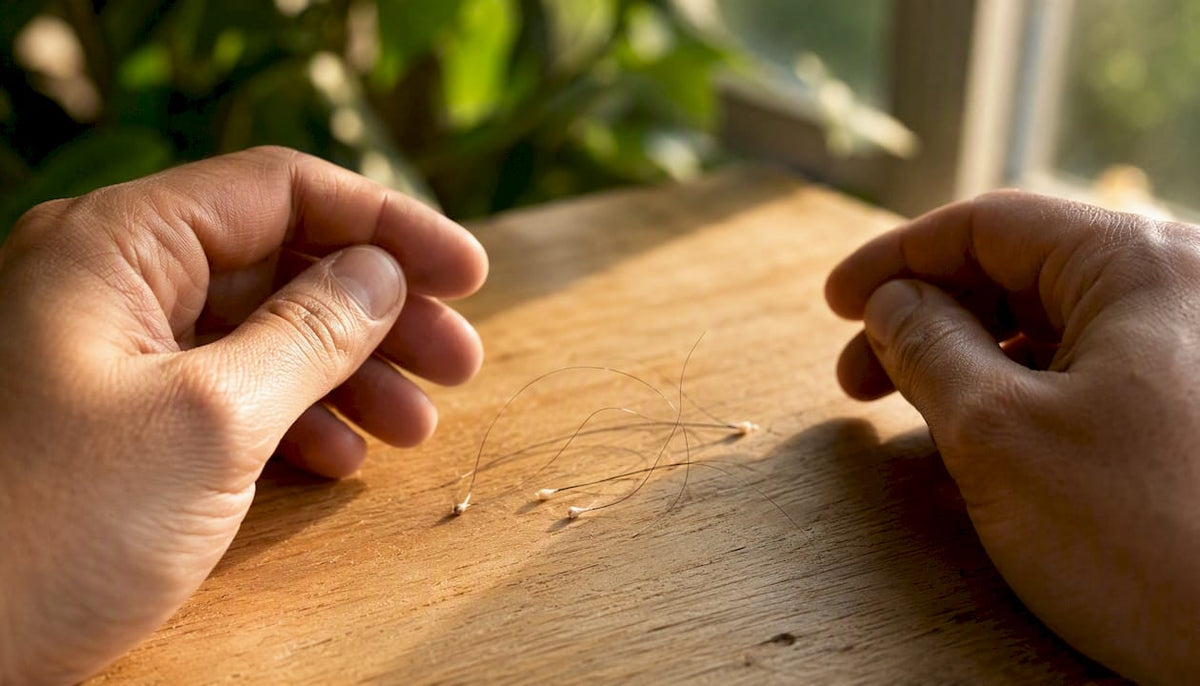
Distinguishing new growth from breakage is important. New growth hairs taper to a fine point at the tip and are often lighter in colour. Broken hairs have a blunt, frayed end. If you are seeing lots of short hairs with blunt ends, that is breakage from mechanical stress, not regrowth.
Practical tracking methods:
- Take a standardised photo of your parting under consistent lighting every four weeks.
- Keep a brief symptom diary noting daily shedding counts and any scalp changes.
- Use the hair growth cycle guide on Livdor to understand what phase your follicles are likely in.
For established androgenic alopecia (male or female pattern hair loss), massage alone is unlikely to reverse significant miniaturisation. It is a supportive tool, not a replacement for medical therapies.
A clinically minded routine: combining massage with evidence-backed treatments
Massage is most effective as part of a multi-modal plan. Clinics that manage hair thinning routinely combine daily massage with LLLT, topical serums, and nutritional support because each element targets a different part of the problem. Here is how to build that routine at home:
- Start with daily massage (weeks 1–4). Establish the habit first. Four to ten minutes daily, using the technique described above, applied either to a dry scalp or immediately after serum application.
- Add a targeted serum from week 1. Apply a serum containing biotin, caffeine, and Pro-Vitamin B5 before your massage session. The mechanical action helps drive the actives toward the follicle. Livdor’s hair growth serums are formulated specifically for this purpose.
- Introduce LLLT from week 2 onwards. A 650nm medical-grade laser cap delivers photobiomodulation directly to follicle cells, stimulating cellular energy production in a way that massage alone cannot replicate. Use it according to the manufacturer’s protocol, typically three to four sessions per week.
- Support from within. Biotin gummies provide the nutritional substrate for keratin synthesis. Livdor’s hair growth vitamins include biotin alongside complementary nutrients. Take daily with food.
- Consider a rosemary and saw palmetto shampoo and conditioner. Rosemary has some evidence for follicle support; saw palmetto is studied for its potential to moderate DHT activity at the scalp. Using both as part of your wash routine adds another layer without adding time.
Why combination therapy outperforms massage alone:
- LLLT stimulates mitochondrial activity in follicle cells directly, a mechanism massage cannot reach.
- Serums deliver bioactive compounds to the dermal papilla; massage improves their uptake.
- Nutritional support addresses deficiencies that can accelerate shedding independently of scalp condition.
Clinical consultation note: If you suspect an underlying medical cause for your hair loss (thyroid issues, iron deficiency, hormonal changes, or a family history of significant alopecia), speak with your GP or a UK trichologist before combining treatments. Early intervention consistently produces better outcomes than waiting until loss is advanced.
The honest case for scalp massage in a hair-care routine
Scalp massage gets oversold in some corners of the internet and undersold in others. The truth sits in the middle. The evidence is real but modest: a small trial showed measurable thickness gains after six months of daily massage, and a larger survey suggested many people notice stabilisation with consistent effort. Those are not nothing. But they are also not a cure for pattern hair loss, and anyone hoping to reverse significant thinning with fingertips alone will likely be disappointed.
Where massage genuinely earns its place is as a scaffold. It prepares the scalp, improves circulation, and creates the ideal moment to apply serums that need to reach the follicle. Done consistently, it also builds the kind of daily ritual that keeps you engaged with your hair health over the months it takes for any treatment to show results. Consistency, in my view, is the underrated variable. A modest technique applied every day for six months will outperform an intensive session done sporadically.
The other thing worth saying plainly: if you are in the early stages of thinning, now is the time to act. The follicles that are miniaturising but not yet dormant are the ones most responsive to intervention. Pairing massage with LLLT and targeted serums at that stage gives you a genuinely meaningful chance of slowing or partially reversing the process. Waiting until loss is advanced narrows your options considerably.
Livdor’s at-home hair health system: LLLT, serums, and smart supplementation
Scalp massage is a strong foundation. Livdor’s laser hair growth products are designed to build on it.
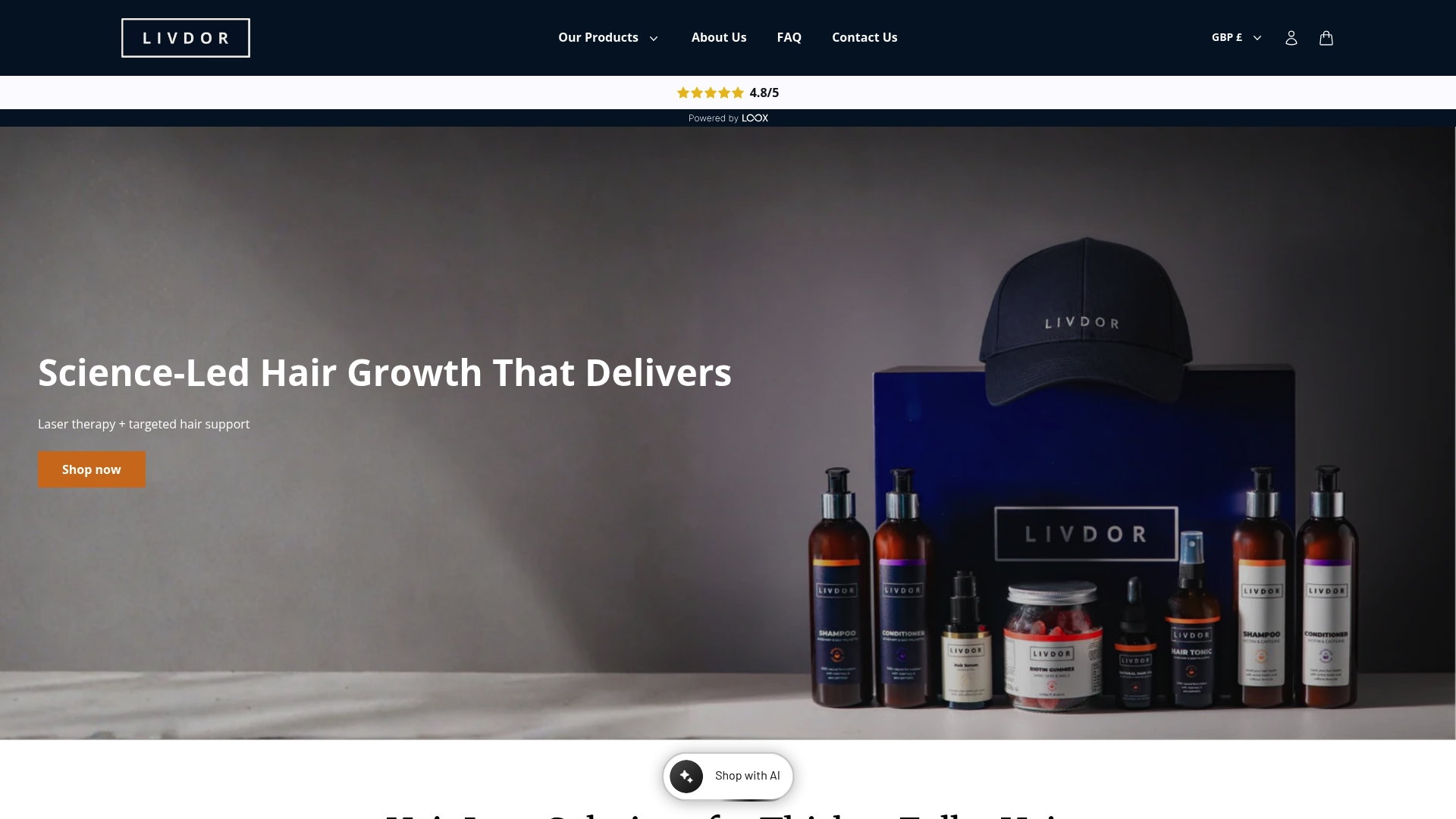
The Livdor 650nm medical-grade laser cap delivers clinically studied LLLT directly to the scalp, stimulating follicle cells at a cellular level that massage alone cannot reach. Pair it with Livdor’s Hair Growth Serum (biotin, caffeine, Pro-Vitamin B5) applied before your daily massage, and you create a routine where each element reinforces the next: massage improves serum uptake, LLLT energises follicle cells, and biotin gummies support keratin production from within. The full Hair Growth Starter Kit bundles these elements together for readers who want a complete, ready-to-use system. All products are drug-free, designed for at-home use, and backed by a comprehensive warranty. For advanced or medically driven hair loss, a UK clinician or trichologist remains the right first call.
Sources
The sources below are the primary references used in this article. Primary research is marked accordingly.
- Standardized scalp massage results in increased hair thickness by inducing stretching forces to dermal papilla cells in the subcutaneous tissue (Eplasty / PMC)
- Survey study reporting participant-reported improvement following scalp massage (Springer)
- Inconclusive if scalp massage stimulates hair growth (UCLA Health)
- Scalp massage for hair growth: does it really work? (Healthline)
- Health
For personalised advice, consult your GP or a registered UK trichologist, particularly if you suspect an underlying medical cause for your hair loss.
This article is general information, not a substitute for advice from a qualified doctor. Consult a qualified healthcare professional about your own circumstances before acting on anything here.
FAQ
Does scalp massage really help hair growth?
Small clinical evidence suggests it can increase hair shaft thickness with consistent daily practice, but it is not a proven cure for hair loss conditions such as androgenic alopecia. UCLA Health describes the overall evidence as inconclusive and calls for larger trials.
How long should I massage my scalp for hair growth?
The Koyama trial used 4 minutes daily over 24 weeks and reported measurable thickness gains. Clinicians cited by Health.com often recommend 10–20 minutes per day for people actively managing thinning; starting at 4–5 minutes and building up is a practical approach.
What are the big three for hair regrowth?
There is no single universally agreed “big three,” but clinicians commonly combine daily scalp massage, LLLT (such as a 650nm laser cap), and a targeted topical serum containing biotin, caffeine, and Pro-Vitamin B5. Adding nutritional support such as biotin gummies addresses the internal side of the equation.
Does scalp massage reduce DHT?
There is no direct clinical evidence that scalp massage lowers DHT levels at the follicle. Caffeine-containing serums applied during massage have been studied for their potential to counteract DHT-related miniaturisation, and saw palmetto in shampoos and conditioners is similarly researched for this purpose, but massage itself is not a DHT-blocking intervention.
How do I tell new growth apart from hair breakage?
New growth hairs taper to a fine point at the tip and are often lighter or finer than mature strands. Broken hairs have a blunt, frayed end. If short hairs around your hairline or parting have blunt ends, that is a sign of mechanical breakage rather than regrowth, and it may be worth reviewing your technique or tool choice.

Leave a comment
This site is protected by hCaptcha and the hCaptcha Privacy Policy and Terms of Service apply.